
Three measurements that tell you more about a raw material than its certificate
Why melt flow rate, density and moisture matter in the production of film, pipe, profiles and sheet
A certificate of analysis has never extruded a single metre of film. The raw material does, and in many plants it reaches the hopper without a single in-house measurement.
Same trade name, same supplier, same certificate of analysis. Yet after a change of batch the extrusion line behaves differently: the bubble loses stability, pipe wall thickness drifts out of tolerance, blisters appear on the surface of the sheet. When I supervise line start-ups in different countries, this scenario keeps coming back. The first question I ask is always the same: what do we know about this batch from our own measurement, not from a document?
In most plastics processing plants the answer rests on three basic tests: melt flow rate, density and moisture. They do not replace a full laboratory, but they show quickly whether a batch of raw material fits the window the process was set up for.
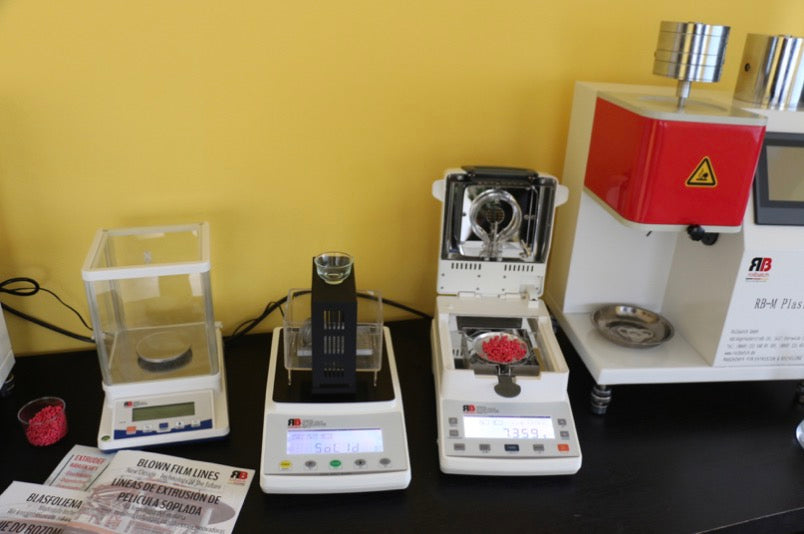
Quality control laboratory: density meter, moisture analyser and Rolbatch plastometer
Melt flow rate: how the polymer behaves in the melt
Setting the test conditions on the Rolbatch plastometer control panel
The melt mass-flow rate (MFR) is the mass of polymer in grams that flows through a capillary of standardised dimensions in 10 minutes, at a defined temperature and under a defined load. Its volumetric counterpart is the melt volume-flow rate (MVR), expressed in cm³ per 10 minutes. Many people still use the older term melt flow index (MFI). The test is carried out on an extrusion plastometer according to ISO 1133-1 or ASTM D1238.
The result is an indirect indicator of melt viscosity and therefore of the molecular weight of the polymer. A lower value usually means a more viscous melt with higher melt strength; a higher value means a melt that flows more easily. A result is only meaningful together with its test conditions, for example 190 °C and 2.16 kg for polyethylene or 230 °C and 2.16 kg for polypropylene. Comparing values measured under different conditions makes no sense.
What a plastometer gives you in practice:
- incoming goods inspection: comparison with the technical data sheet and with previous batches,
- assessment of recycled pellets, whose properties vary from batch to batch far more than those of virgin polymer,
- a check whether the polymer has degraded in the process, by comparing the pellets with the finished product,
- factual data for discussions with suppliers and for complaints.
Density: composition and structure you cannot see
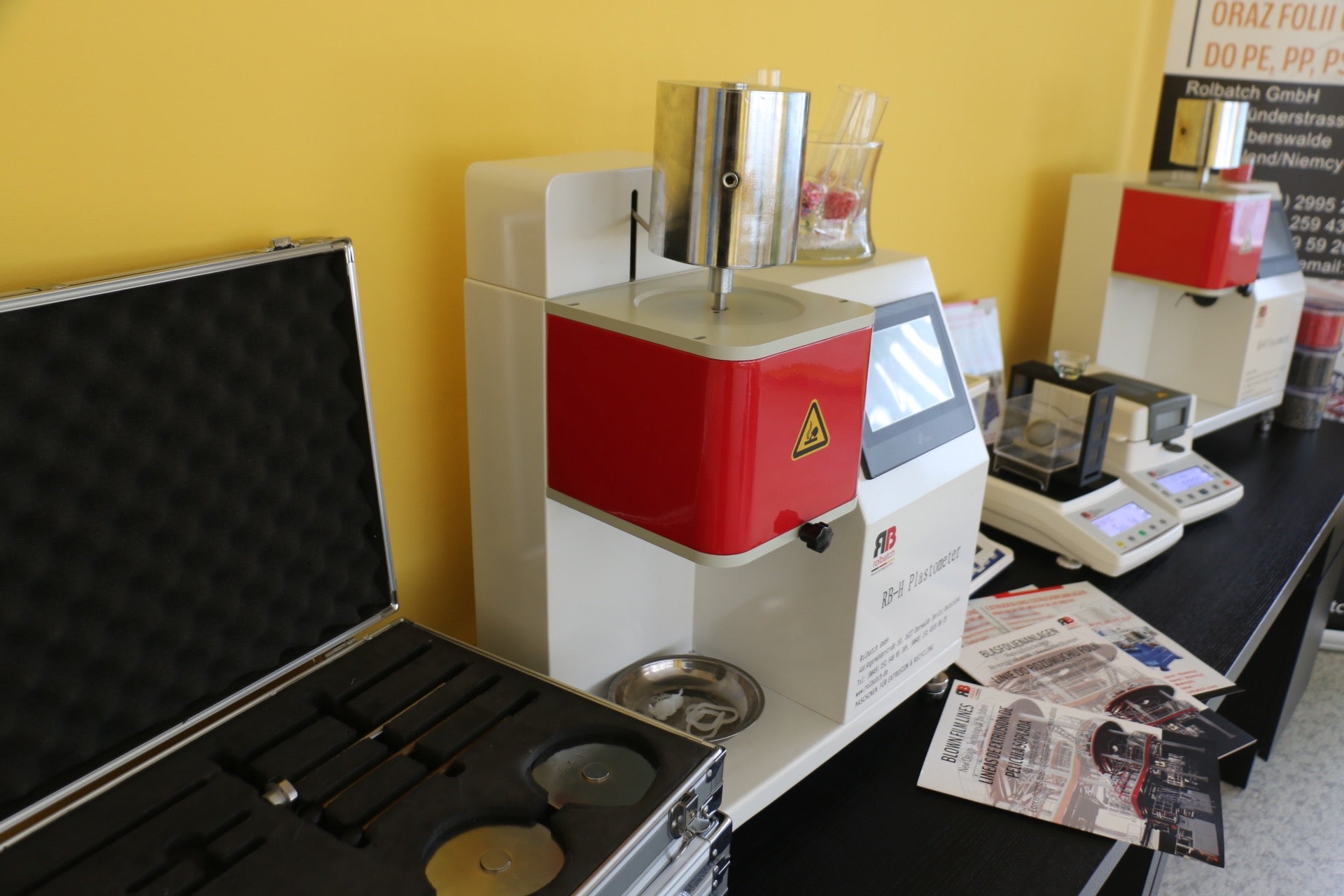
Rolbatch plastometer with accessories, density meter in the background
The density of plastics is most often measured by the immersion method according to ISO 1183-1, using a density meter, i.e. a balance with a hydrostatic weighing kit. The specimen is weighed in air and in a liquid of known density, and the result is given in g/cm³.
In polyethylene, density is linked to crystallinity. It is what distinguishes LDPE (low-density polyethylene), LLDPE (linear low-density polyethylene) and HDPE (high-density polyethylene). It translates into film stiffness, sealing behaviour and water vapour barrier. Differences between grades often appear only in the third decimal place, so the measurement has to be accurate and repeatable.
In recycled pellets and filled compounds, density is a quick signal that something has changed: a higher share of mineral filler such as calcium carbonate, contamination with another polymer, or voids in the pellets. The figure alone does not identify the cause, but it tells you it is worth checking before the batch reaches the hopper.
Moisture: the most underestimated parameter
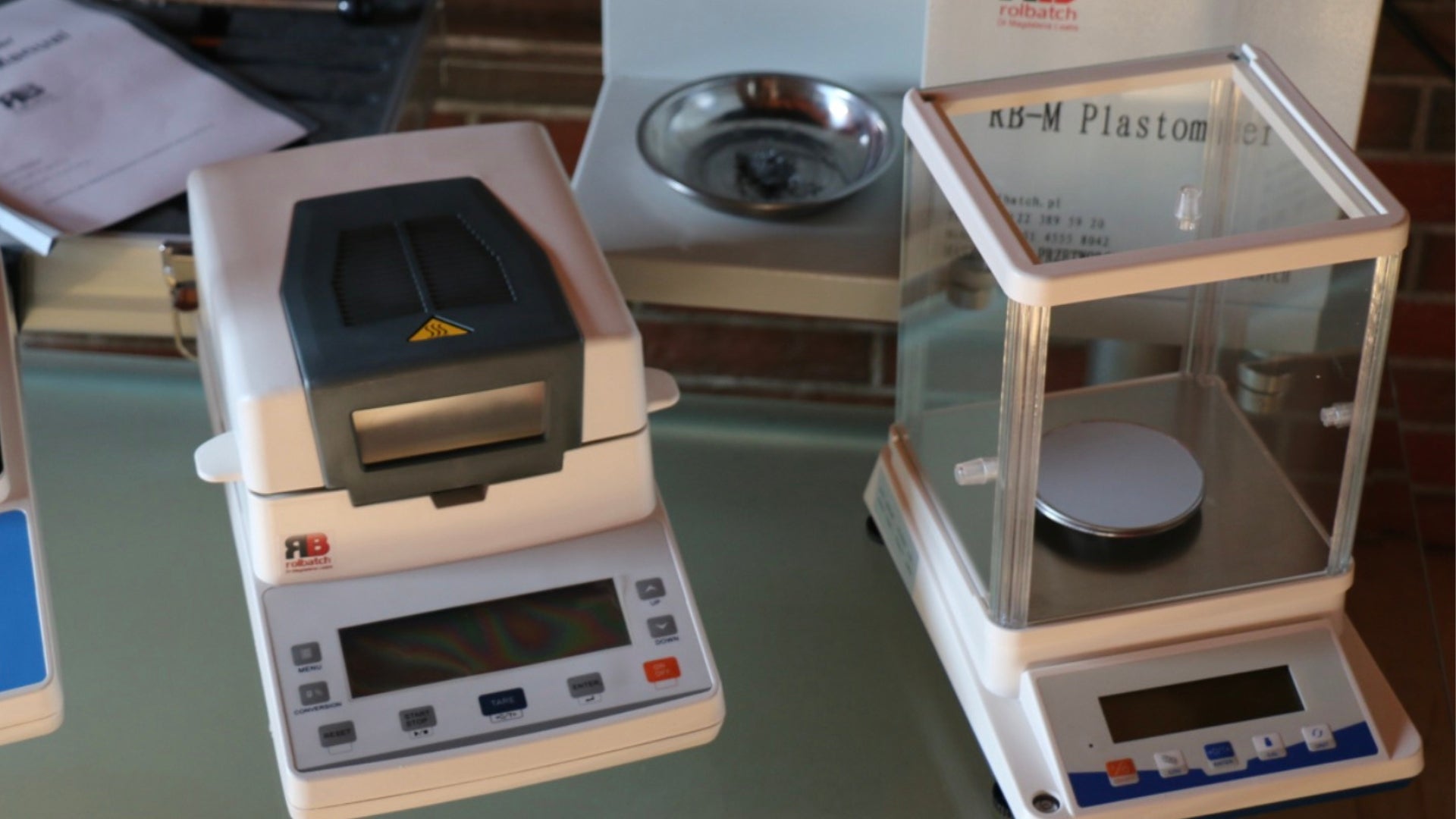
Rolbatch moisture analyser and density meter
Moisture in raw materials is usually measured with a moisture analyser, a balance with a halogen heater. The instrument weighs the sample, heats it and reports the loss of mass in per cent. This loss includes water and other volatiles. When the water content alone is needed, Karl Fischer titration is used.
How much moisture matters depends on the polymer. Hygroscopic polymers such as PET, PA, PC, PMMA and ABS absorb water from the air. In PET and PC, water at processing temperature causes hydrolysis, which breaks the polymer chains. The result is lower melt viscosity and poorer mechanical properties of the product, often not visible straight away.
Polyolefins, PE and PP, are not hygroscopic, but that does not mean moisture is irrelevant. Washed recycled pellets, calcium carbonate filled compounds, colour masterbatches, raw material moved from a cold warehouse into a warm production hall: in each case, water on the surface or inside the pellets can cause bubbles, holes in film or voids in pipe walls.
Moisture also affects the plastometer result. Wet PET or PA hydrolyses inside the plastometer barrel, so the melt flow rate comes out too high. A good laboratory procedure therefore checks moisture first and melt flow rate second.
Film, pipe, profiles, sheet: different products, different questions
Blown film
In blown film extrusion, melt flow rate has a direct influence on how the melt behaves after leaving the die. A melt with too low a viscosity holds a stable bubble less well; a melt with too high a viscosity raises melt pressure and drive load. Density tells you about film stiffness and sealing and helps control the ratio of LDPE, LLDPE and HDPE in the blend. Moisture in recycled pellets and masterbatches is a frequent cause of holes and bubbles in the film.
Pipe
Polyethylene pressure pipes are extruded from grades with a very low melt flow rate, usually stated on data sheets at 190 °C and 5 kg. Product standards compare the melt flow rate of the compound and of the pipe to show that the material has not degraded during processing. Density is one of the basic characteristics of pipe compounds and helps detect deviations in composition. Moisture leads to voids in the wall and a rough inner surface.
Profiles
For profiles made of PE, PP and wood-plastic composites (WPC), the plastometer is used in the same way as for film and pipe. PVC profiles are a different case: PVC degrades easily during the test, so other methods are used to assess its flow and the plastometer plays a smaller role. This makes density, which reflects changes in filler content, and the moisture of the dry blend and of the fillers all the more important.
Sheet
Sheet is extruded from PP, HDPE, PS, ABS, PMMA, PC and PET, so many grades are hygroscopic. Insufficiently dried material causes bubbles and streaks on the surface and, in PC and PET, a loss of mechanical properties. Melt flow rate matters both in extruding thick sheet and in later thermoforming, when the heated sheet has to keep its shape. Density helps control filler content, for example talc in PP sheet.
One measurement is a signal, not a diagnosis
None of these three measurements tells the whole story. A result outside the expected range is a signal to check the possible causes, not a finished answer. The real value lies in results collected regularly: with every delivery, with every change of recycled batch, with every complaint. Only then do trends become visible and supplier discussions are based on figures rather than impressions.
Two things are easily overlooked: regular checks of the instruments and training of the people who carry out the tests. A plastometer with a contaminated capillary or a density measurement with air bubbles on the specimen gives figures that look credible but lead to wrong decisions.
Plastometers, density meters, moisture analysers and courses
At Rolbatch we supply RBH2 and RBM2 plastometers, density meters and moisture analysers for laboratories in plastics processing and recycling plants. At Rolbatch Academy I run online courses in this field: from the basics of moisture, density and melt flow rate, through MFR and MVR testing to ISO 1133 and ASTM D1238, to the day-to-day operation of a plastometer, density meter and moisture analyser in the laboratory.
How does incoming goods inspection work in your plant: do you measure yourselves, or do you rely on the supplier's certificate of analysis?
About the author
Dr Magdalena Laabs, Managing Director of Rolbatch Engineering GmbH and founder of Rolbatch Academy. Expert of the Association of Mechanical Engineers and Technicians SIMP in two specialisations: Materials Engineering (specialisation 109) and Plastics Processing Machinery and Technology (specialisation 215).
Sources and links
- ISO 1133-1 Plastics. Determination of the melt mass-flow rate (MFR) and melt volume-flow rate (MVR) of thermoplastics. Part 1: Standard method
- ASTM D1238 Standard Test Method for Melt Flow Rates of Thermoplastics by Extrusion Plastometer
- ISO 1183-1 Plastics. Methods for determining the density of non-cellular plastics. Part 1: Immersion method, liquid pycnometer method and titration method
- Rolbatch Academy courses on plastics testing: https://www.rolbatch.eu/collections/laboratory-online-courses-lab-quality-plastics
- Rolbatch laboratory equipment: https://www.rolbatch.eu/collections/laboratory-equipment
- Plastometers and laboratory equipment: https://www.rolbatch-laabs.de
- Contact: https://www.rolbatch.eu/pages/contact
Very interesting as useful as a reminder of the basic principles of raw materials reception.